Sunday, January 6, 2013

Biking the Roluos Road Jan 16, 2012

 Jules and I both have a desire to get off the beaten track whenever possible.  Lloyd got us booked on a really different kind of sight-seeing tour; the two of us, with one guide, on bikes, riding out of Siem Reap about 15 kilometres to the Roluos  Group.

This is the site of the first Khmer capital, dating to around 875 AD.  It's outside of the more well-known Angkor area, and although you can get here by bus, it's far more fun to ride.
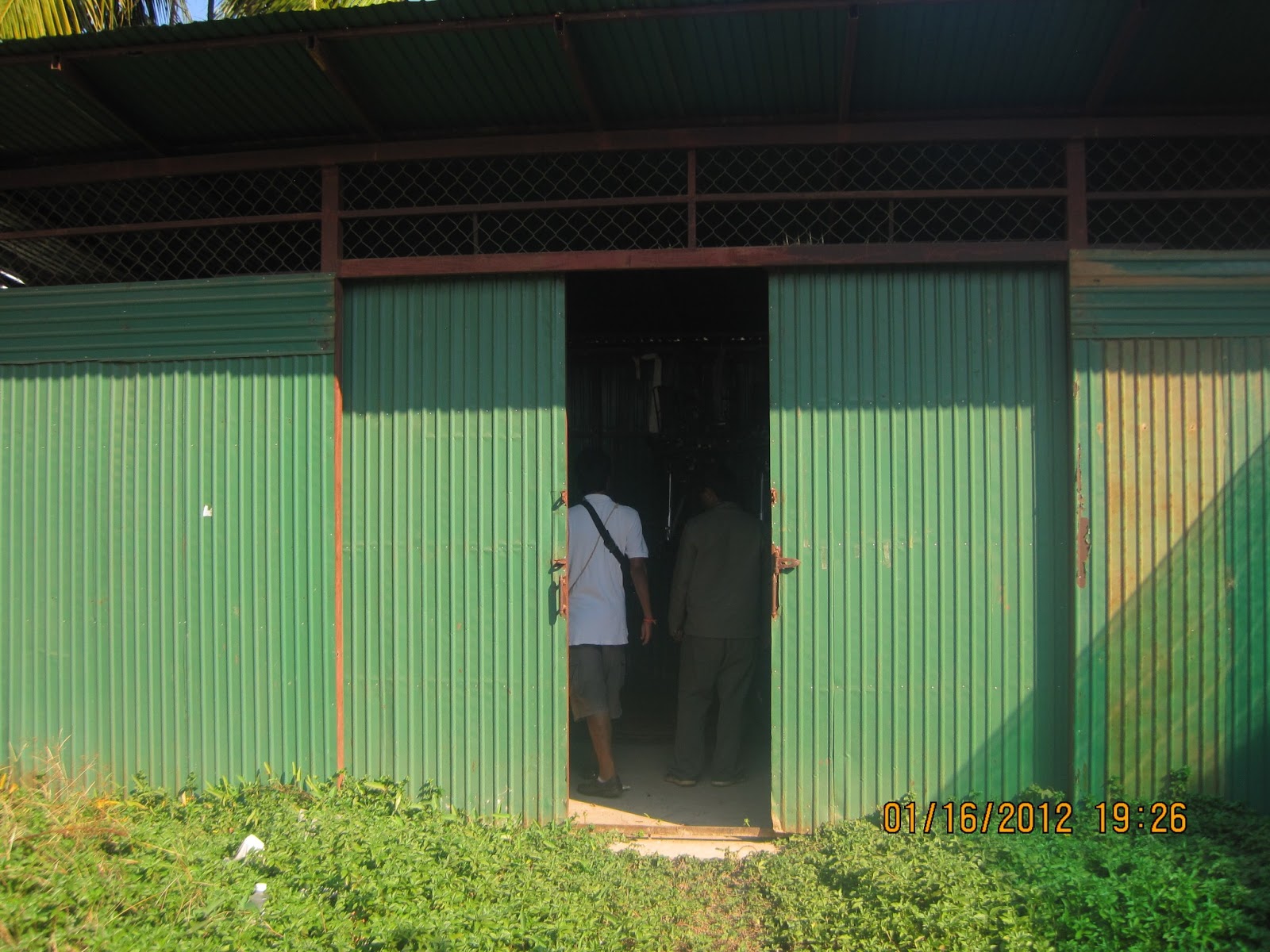
Our small van from the hotel took us to this non-descript yard with a large shed in back.  Opening the shed, our guide helped us select our steeds for the day - brand spankin' new Specialized Hardrock mountain bikes.


And we're off!   Chan Mol, our guide, took us through the outskirts of Siemp Reap onto the red dirt roads of the countryside.  We passed by school kids on their way back to school from their lunch breaks, and Chan Mol explained that many of these kids are orphaned.  The government and the U.N. are trying to support them with aid and education, but it's a struggle. 


It was wonderful to breathe the fresh air outside the city.  And the feel of this more rural village and farm land was so much like the old Laos I remembered around Vientiane, I felt right at home.  Tension melted away, replaced with joy in the return of life's rhythm.   The ditches enabled at least two rice harvests a year here, and many people are getting enough to eat.  There are many new jobs, and new construction evident.  Chan Mol says there is now a real feeling of hope - I think it's fragile, and certainly nobody seems to hold much faith in the myriad political parties, but "normal" life is a welcome gift.


The old woman warned us.  We stopped for a water break, and as we applied more sunscreen and insect spray, she talked to Chan Mol about our questionable actions.  Translated, she said: "That goopy stuff you are putting on your skin is going to be a mistake." 


She was right. In short order, we were coated in a thick layer of red dust. It was a day when you just have to stop thinking about sweat, dirt, and chemical goopey stuff.


Perfect weather, idyllic scene - and every half-mile or so, we'd see a different political party sign.  Chan Mol seems to think it's not really going to make much difference who wins - they are all well-meaning, but what we call "bribery" or "corruption" is common. It's just the way the world works.  People are resigned to this, and it does seem a small issue compared to gaining peace.


The local gas station.  Whiskey bottles are used for measuring litres of petrol.  There was also a compressor for tires here, and soda in a cooler.


The white Brahma oxen were unchanged from 40 years before.  At one point, we steered our bikes around a herd of them being guided down the road.  I was hoping Jules would know how to maneuver around them without spooking them, since she was ahead of me.  I should never have doubted!  


 We came upon an open-air temple/gathering place for the community, with murals of Buddha's life and journeys.  A bright spot along the road.


Typical road-side home.  Under the stilted floor, the animals live.  Chickens, goats, cattle, pigs take shelter from the sun during dry season.


Chan Mol described the process of rice growing, drying, and storing in these thatched "sheds".  


This woman was probably in her 40's, and wrestling with this home-grown building material, used for roofing.


By this time, we were ready for a break.  We'd been biking for a couple of hours at least, and the lunch spot was our oasis in the desert.  Covered with red dust and sweat, we pretended we were just as presentable as the Europeans lunching next to us.  

We kept going, and finally arrived at the Roluos Group of Khmer temple ruins.
This was a completely different experience from our day at Angkor Wat.  Peaceful, free of tour buses and crowds, the sound of birds replaced the sound of motorbikes here.  The ruins themselves are less groomed, with grass and native ornamental plants growing on nooks and crannies.  Exquisite carvings made in 1100 years ago coexist with foliage, setting off the beauty of the artwork.  Here, you can feel connected through that thousand years of time to the presence of the gods and the people who spent so many years worshiping them through art.


Roluos, Preah Ko, the Six Towers.
This temple was dedicated to Shiva, and means Sacred Bull.  (Nandi, Shiva's mount) Hindu mythical creatures are carved here, and Garuda.


Chan Mol explained that the method of making cement to hold the layers of brick and carving stone together is quite advanced at Roluos. It's an older area than Angkor, and not all the skills transferred to the newer building north of Siem Reap.


We never learned where the rest of this god is; seems to have walked off without his toe-shoes.  


The elephants on the temple of Bakong, 881 AD, originally dedicated to Shiva but later a place of Buddhist worship.  


No signs told us about whether these doors really opened or not.  More research to do...!  


As we explored, and occasionally just sat and rested, we got to know our guide.  Jules again was able to ask questions that I could not.  One of Chan Mol's  hands was missing some fingers.  By this time, we all felt quite comfortable with one another, and we learned that he had lost his fingers in a wood-saw that he was running with his father.  His father felt so guilty that this had happened (Chan Mol was in his early teens then, I think) that he promised his son that he would pay for him to go to school, so he would be able to have a way to make a living.  
Chan Mol's older sister was at school, and it was expensive to go beyond the elementary level.  So for Chan Mol to get to go too was quite a challenge for the family.  Currently, he has gotten through secondary education, and is taking college level classes when he can, earning his way through by working as a guide. His English is really very good, and he was very happy to learn from us as well.

Chan Mol's mother wants him to get married and have a family.  But he wants to wait until he can really support a family; and before his father died, he agreed with Chan Mol on that issue.  So Mom has now accepted his decision, but not too happily!  

Next, we learn about Chan Mol's survival during the last years of the war.  And we learn the technique of surviving Siem Reap traffic in the dark, on a bike.

Thursday, January 3, 2013

Cambodia At Last

Angkor Thom - Hidden Buddha
I'd dreamed about Cambodia; the misty jungles, the ruins of Angkor, feeling the spirits just out of my range of vision.  Everyone's romantic idea...and it's there, alright, but seeing it all as it was a century ago will take digging through many layers of time.
A lot has happened here... and the spirits are not yet at peace.  

According to my Dad's memoirs, around 1970, during our time in Vientiane, my brother came home one day and said, "Hey, guess what? Our class is going to take a trip to Angkor Wat. We're going to fly down on Royal Air Lao..." Dad's reaction was less than enthusiastic.  "You WHAT?  Whose *@#! idea was THAT?!"  'Since Royal Air Lao planes were unsafe even sitting in the hangar, and Angkor Wat was infested with NVA, Viet Cong, and Khmer Rouge, that flap was over before it even started.  A certain teacher got a lecture on the realities of Southeast Asia...'"

For almost all of these last 40 years, Cambodia has suffered unimaginable hardships - bombing by the Americans during the war, the genocidal terror of Pol Pot's rule, and the running battle with the Vietnamese for control.   If PTSD is something one can diagnose in a soldier, imagine a whole nation suffering from the effects of indescribable trauma.  There is a reality here that very few Americans can truly absorb.  I know I can't.  I think we can only learn, and pay respect, and do what we can to help.

Lloyd got us booked on an Angkor Wat tour for our first full day in Cambodia, after flying into the city of Siem Reap from Luang Prabang.  Flying in, we could see the huge Tonle Sap Lake, and the magnificent barays, reservoirs, built by the Khmer Empire in its heyday.  Flat, misty land, with grass, rice and forested areas stretched to the more mountainous north.  We could sense that vision of the past - but once we landed, it was gone.   

Our driver was waiting for us, with a name sign.   And of course, before we got to the hotel along the paved highway to Siem Reap, Jules had the life story of the driver.  He was Thai, and had come to Siem Reap for more of a future (that was an eye-opener!).  He was learning English, working as a guide, and was taking classes at a college.  He felt there was less competition for jobs here than in Thailand.  But Jules found out the more personal reason.  He had been jilted by his long-time girlfriend in Thailand, and wanted a change of scenery.  We wished him much luck on all endeavors.


So, forty years after the cancelled field trip, Jules and I have finally gotten here to Angkor Wat.  Us, and everyone else. Visitors number in the millions per year, and we were part of that number now.

This was the road in.  Jules and I were signed up with a tour group of about 10 people, mostly Australians.  Bus from hotel, bus from crowded ticketing area, and then on foot with our guide.  The photo shows the stream of locals coming in to work at Angkor, and the tourist wave hitting at the same time.  The air smelled of dust and diesel fumes, and any spirit voices were drowned out by honking, multi-lingual chatter, and motorbike engines.
This is a work day, if you are lucky.


Visiting with the monks near the entrance to Angkor Thom was a good way to get our heads straight, calm down, and get the smile in place.  


Five towers of Angkor Wat and Moat
We walked up through the compound of Angkor Thom first, then wound our way back through Angkor Wat, and many of the other ruins.  I won't give you all the history and architectural information here - there are much better sources for that. Here are images, and a few stories.  


The waterworks are an engineer's dream.  Far more advanced than anyone suspected, recent discoveries have shown a vast network of water channeling and storage than enabled the civilization to keep a stable food supply.


The hallways have no roofs now, but the artwork carved into the walls still tells the stories of warfare and celebration of victories from the Hindu epic Mahabharata. 
The Tomb Raider Tree at Ta Prohm
Aussies.  We learned a few things from this group - first, they say Americans are amateurs at drinking.  Evidently, we just can't handle it, get way too out of control way too early.  Australians, at least this pack, take pride in being able to drink anyone under the table and still carry on the adventure.
Which was really ironic to hear, since the two ladies actually left the tour for a couple of hours due to hang-overs.  But they did catch us up later, so maybe that gets them some gnar points.
Jules and I couldn't really contest their claims, after reading that an American had just died in Vang Vieng - imbiding and tubing are not a good combination.
These folks were a great bunch to tour with, always cheerful and living in the moment!
 Elephant Terrace, where elephants were trained and parades held.  


Jules, being a dancer, was looking for Apsaras everywhere.  These lovely ceremonial dancers were the icon of Angkor.    They were carved in many different styles over the centuries, but always delicate and balanced, each more graceful than the one before.

We did a LOT of climbing up and down.  Very steep climbing, and getting around the larger varieties of Europeans without offending became a game of strategy.  Jules and I aren't exactly long legged people, so it was a welcome workout.


STRANGLER FIGS.  These trees are endlessly fascinating.  They are a real problem for the archaeologists trying to preserve the Angkor ruins, since they grow through the stone, cracking and crushing the blocks.  The trees only live a couple hundred years, and can then topple, bringing down whole sections of walls.   The dilemma is how to remove them without damaging the stonework.  Sometimes, the tree is the only thing holding it all together.
And if you love the organic, fractal look of them, it's hard to think about killing them!    


There were place that had their own special beauty, even in destruction.


    And there are always those stairs and doorways that are irresistible.  We were not allowed to go down there.  It was really pretty amazing that we were able to clamber all over most of these ruins, and I doubt that will be the case much longer.


We were always looking for the edge of the forest, wondering what remains to be discovered outside the groomed boundaries.  
There is plenty, and as Cambodia stabilizes, more and more clearing and excavation is occurring.  What a great time to be a young archaeologist!   

I wonder, too, what it's like here in the rainy season.  Probably perfect - quiet, calm, and the air would smell of forest and not diesel.


Realities of the warfare are easy to spot.  Here at Angkor Wat, we strolled through the cool echoing galleries where stone Buddhas and Hindu Gods resided.  Pol Pot's Communist guerrillas destroyed these at every opportunity. Buddha still has dignity, even headless.


Bullet holes were visible in many parts of the walls and pillars.  


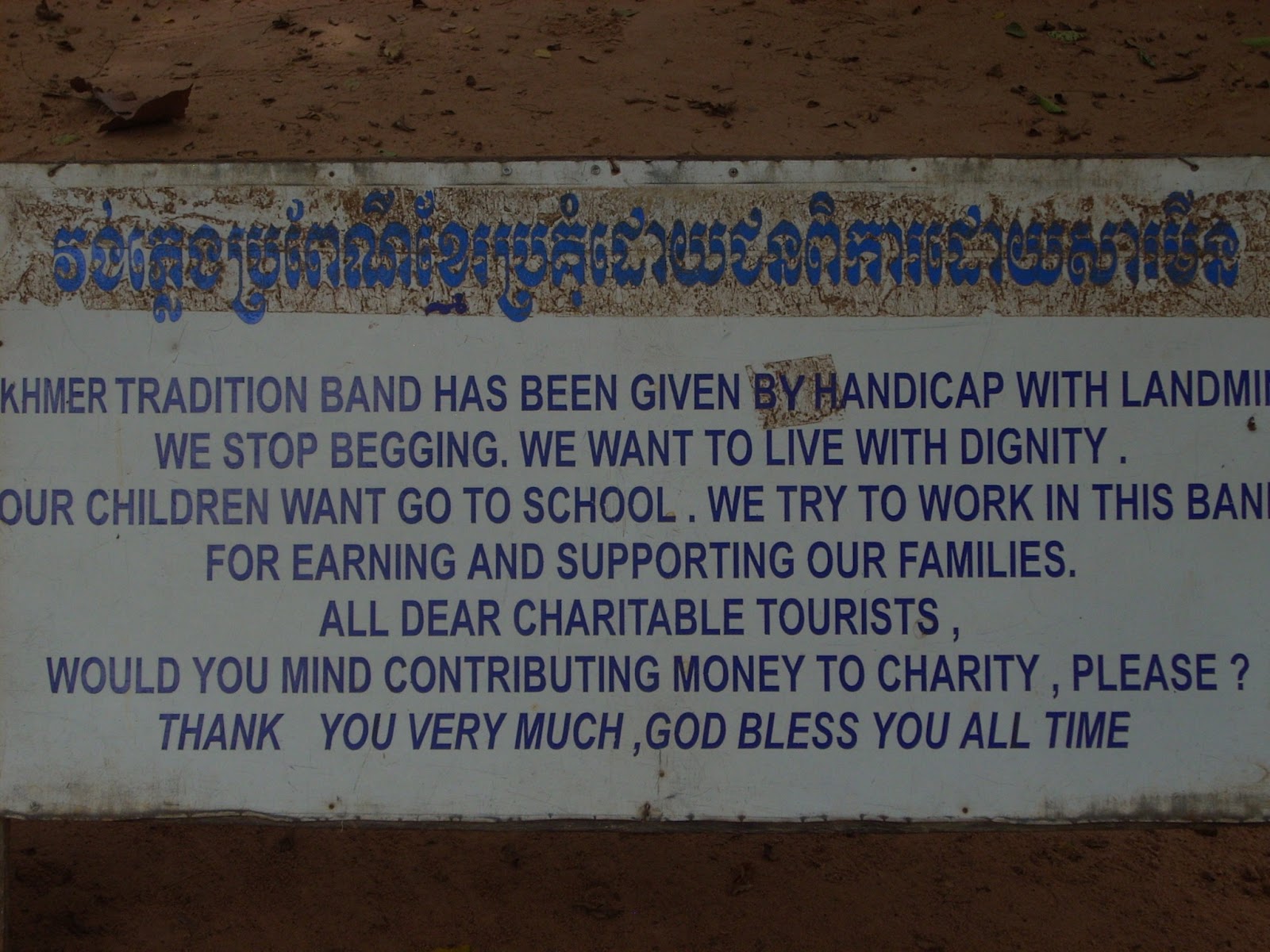
The human toll of the long years of war cannot be measured.  I watched as some Chinese tourists, Europeans, and Australians passed by these musicians, possibly suspicious that they might be less than authentic.  But it's no gimmick.  In Cambodia Now: Life in the Wake of War, Karen Coates describes the lives of these men as they have had to cope with their injuries in a nation that is struggling to overcome a crippling past itself.


The band sounded really good, too - traditional tunes, played with pride.

The landmines and UXO problem is still severe, but improving.  And in the meantime, we pay the dollar every time to hear a tune or two.


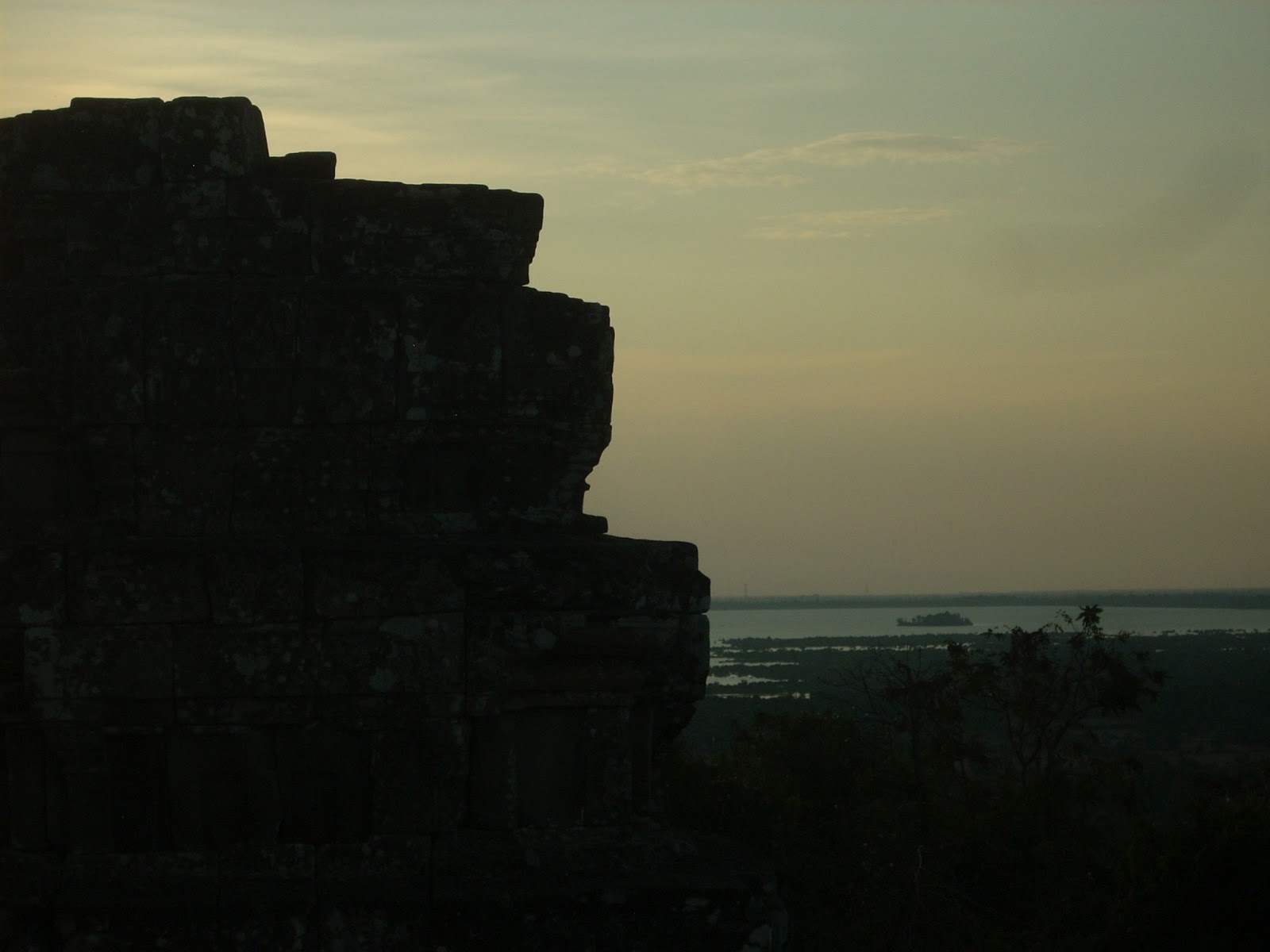
Our last stop for the day was the traditional sunset view of off Phnom Bakheng, the 9th century state temple of the first Khmer capital.  But it wasn't the history that drew the monks, the Chinese New Year tourists, and the school groups - it was the view.  We could see the Angkor Wat complex, the West Baray, and forests extending north.  We watched the sun go down over the countryside, with smokey haze from cooking fires in the far-off villages.


I wish there was a way to convey it.  It was peaceful here.  The few who lasted til sunset were quiet, and tired; happy to just sit and gaze.  As the night's cicadas began, and the moisture rose from the ground, we started to feel we were in Cambodia as it has been for a thousand years.
We headed back to our van, feeling as if we had been here for a long time - just the first day.  Tomorrow, we had a new adventure planned, that would put us in that countryside, and even coated with it.  We will find the older Cambodia, and the Laos I remembered too.